



A sophomore at an unnamed college cites the syllabus for the photography course he/she/they are taking that bans the use of kit lenses. The back story from a post on Reddit is in this screenshot of the syllabus:

A pro photographer and educator weighs in
I choose not to use kit lenses on my cameras for two reasons: First, I am a pro and appearances and durability matter. Second, all of the cameras I regularly use are full-frame and 18-55mm lenses don’t cover the format.
That said, I have a 17-year-old Canon 20D with an 18-55mm f/3.5-5.6 kit lens that works just fine. As a matter of fact, several photos in the “Dummies” book I wrote were made with it and the kit lens that came with it. The point of college or any photography classes is to teach photography and advise about not dictate equipment purchases.
I take offense at the line “Student work from this class has been licensed commercially as stock photography, but if you shoot with an 18-55mm lens, you are putting your work at a serious disadvantage quality-wise.”
Give me a [insert 7-letter word beginning with F here] break! I’m sure the instructor imagines that their student’s photos sold by a stock agency are going to be blown up billboard size and here’s a reality check. Digital billboards on highways have a resolution of 1920-by-1080 pixels for the most part. That’s right. Billboards are huge HD monitors.
Stock photos that appear on websites like Photofocus aren’t big either. We use 2560-by-1440 pixel photos for the opening picture and 1600 pixel wide photos to illustrate articles. For context, the screenshot of the Reddit article above is 1600 pixels wide.
Kit lenses rock
Like the adage, the best camera is the one you have with you, the lens that comes with your camera is the best one you have when you got the camera. Obvious, right?
While kit lenses are definitely cheaply made with lots of plastic and they feel cheap and cheesy, they work just fine for learning photography and as you’ll see below for quality work. College photo courses must teach how photography works. Any adjustable camera with a manual setting for exposure — shutter speed, aperture and ISO are great learning tools.
Wide-angle, normal and telephoto in one lens
The Canon 20D has an APS-C crop sensor. The camera’s normal focal length is 28mm. Any focal length less than that is a wide-angle. Longer than 28mm means it’s a telephoto. So at 18mm the kit lens is a moderate wide-angle and at 55mm it’s almost a 2x magnification telephoto. (Divide the normal into the telephoto focal length to get the magnification. This is not to be confused with crop factor and I digress.) The point is these plastic beauties are wonderful entry-level learning tools.
Quick tests — startling results
To write this post, I dug out my old Canon 20D I got in 2004. The batteries were toast but the lens was fine. The 20D is an 8.2-megapixel camera with pixel dimensions of 3504-by–2336. Since the camera itself was sidelined, I slipped this kit lens onto my Canon EOS R5 mirrorless camera. With a cropped sensor lens, the R5’s pixel dimensions are 5088-by-3392.
That’s 68 percent more resolution than the camera this kit lens was designed for. This lens is 17 years old! The two sets of photos of foliage and a turntable show remarkable quality. Each pair of photos below are wide-angle 18mm on the left and telephoto 55mm on the right.


WTF?
I get that kit lenses are not the best optics going. I know that they have barrel distortion and chromatic aberration issues. Look at the sides of the turntable on the left. Do you see any barrel distortion? Of course, you don’t. Lens corrections in Lightroom fix it for kit lenses and lenses costing thousands.
I fail to see where the professor gets off denying students the use of kit lenses. The point of photographic education is to learn photography. The knowledge that an instructor passes to their student is the foundation upon which they will build their careers. Why limit students by insisting on a “better” lens when the money spent on one might be invested in props, costumes, locations and creativity.
Remember, professor, it’s not the lens. It’s the lensmanship.
Get over $300 in photo tools for free!
Download more than $300 worth of photo tools! Included are five eBooks, 81 Lookup Tables (LUTs), 94 Photoshop Layer Styles, 20 creative profiles for Lightroom and Photoshop, 54 textures and two full-length video courses!




I have to disagree with you here. While I don’t know your credentials, the tone of your article suggests you are a professional photographer and not an educator. Personally I am an engineering professor and also an avid amateur photographer so I’d like to believe I can see both sides. I definitely agree with you that a kit lens is a decent lens and you can still make good photography with it. However, I think you’d agree that it’s harder for someone to make a great picture using a kit lens. For example, let’s say we’re shooting portraits. If I… Read more »
Hi Siming, Thank you for this thoughtful response. Divergence of opinion presented with respect as you have done is the foundation for discussion. I am a professional photographer. I have been an educator teaching the fundamentals of photography and writing the curriculum for the school’s imaging department’s transition from film to digital and then modifying it when film became an alternative process. Regarding the 80mm f/1.4. You are correct in that the lens is much faster than the kit lens offering more background blurring possibilities. At the same time, the cost of the lenses you are suggesting is beyond the… Read more »
Are they grading equipment or students? Simply have the students define the equipment. The professor should have the knowledge and experience to differentiate between the two. Then they should grade on the creativity of the student.
Hi Paul,
Grading on creativity is important. The other factor is grading on the student’s understanding of how photography works and how to control it so the creativity can be repeated.
Siming, I have just as many doubts about this student’s story as you do. I hardly expect someone’s rant on Reddit to be an accurate assessment of the facts, even with the partial syllabus page included. That said, the Reddit article does say that it is a sophomore, 2nd year class, not a beginner class. Somewhere else I read that it is an editorial photography class and the professor was wanting students to use lenses more commonly associated with a fashion photo shoot, i.e. prime lenses, which the university has available for the students to check out from the gear… Read more »
Just one for the detail to add, which seems to have been missed in the outrage about the professor requiring x y and z. If you read between the lines, the school has a stock of high quality lenses which the students are being asked to check out along with the required lighting equipment. So it seems the professor is encouraging the use of specific lenses but also providing them, and simply advising students not to take a shortcut and use the inferior lens at hand! I don’t teach photography, but I do teach audio podcasting from time to time.… Read more »
Hi Ken, In the Reddit article, the student states, “I own a fancy-ass camera, but the cage has limited hours and even more limited equipment. This just seems asinine.” Depending on the number of students, this would pose a problem for the class in fulfilling the professor’s requirements. Before writing the post, I searched to discover the name of the school and the professor. The student here has done a very good job of covering their behind. I’d love to interview the head of the school’s photography department and the professor as well to tell their side of the story.… Read more »
I’m not a pro and admittedly so. As I understand photography and its history, Pulitzer prizes have been awarded to photographers who have used “toy” cameras, and major exhibitions have included images made with nothing more than a cardboard box and a pin sized hole for an aperture. Is it about the lens, or is it about knowing the equipment and ability to convey the intended message?
Hi Joe,
Telling the story is the point of photography. Great question for all of us to think about. Thanks.
Kevin Ames, I’m a first time reader and, obviously, this is my first time to post. I have question about your article.
Quote: “I have a 17-year-old Canon 20D with an 18-55mm f/1.8 kit lens.”
Do you really have an 18-55mm f/1.8 lens?
Hi Rick,
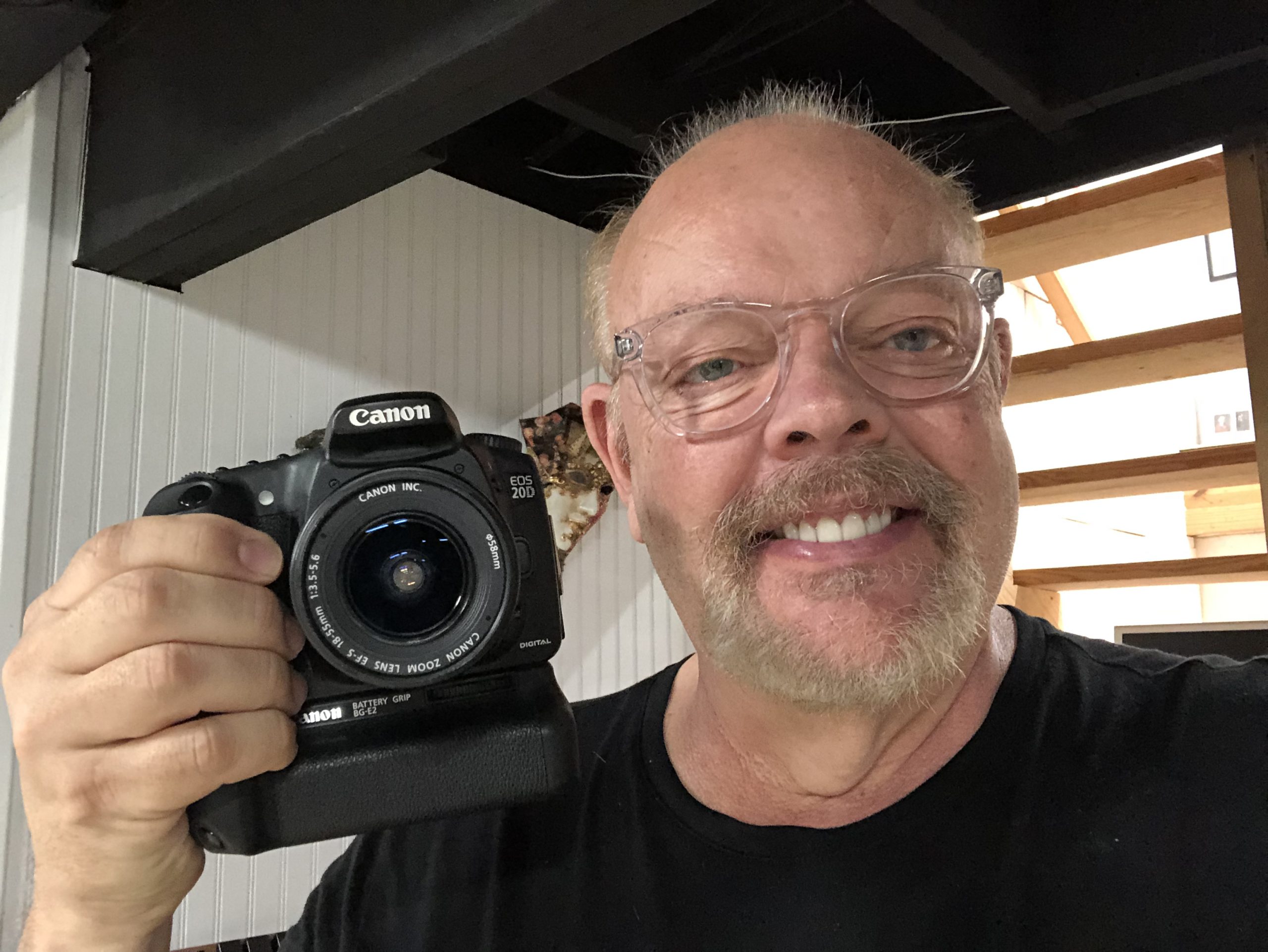
Yup. I do have one. It came with my first Canon DSLR the 20D. But don’t take my word for it. Here’s a selfie with the camera and kit lens I shot a few minutes ago.
Kevin
Isn’t that an f/3.5-5.6 variable aperture lens? I think that’s what I’m reading on the front of your lens, “1:3.5-5.6.” That’s the aperture, right? You were even so kind as to point to it with your index finger.
Hi Rich,
Yes! It is a variable aperture lens. That’s another way manufacturers make these lenses super affordable.
Up in the article, you write that yours is an f/1.8 lens, not an f/3.5-5.6 lens. That’s why I asked, “Do you really have an 18-55mm f/1.8 lens?”
If you have one, great. An 18-55mm f/1.8 lens would be amazing. And that lens as a kit lens, in the context of this article, would make the university professor at the center of this controversy appear to be an even bigger moron. However, I don’t think that an 18-55mm f/1.8 lens even exists. Sigma does have an 18-35mm f/1.8 lens, but it’s a fairly recent release, not 20 years old, and definitely not offered as a kit lens due to the price.
https://www.sigmaphoto.com/18-35mm-f18-dc-hsm-a
Hi Rich,
Sigh. Yes, well that would be an awesome lens but it would be a lot larger and heavier in order to hit a constant aperture of f/1.8. As you point out Sigma makes an 18-35mm f/1.8 for $749.00 which is $300.00 more than a Canon Rebel T7 with an 18-55mm f/3.5-5.6. Again, apologies for my getting the aperture wrong in the article. It has been updated to reflect the correct aperture.
We have adjusted the article to reflect the correct aperture.
Hi Rich,
Thanks for catching my mistake. Great eyes like yours helps make Photofocus better.
Yeah, I was using my reading glasses to catch that. I get how sometimes you’ll stick with the wrong answer because your brain is seeing the correct answer and refuses to let you see the typo. Been there, done that.
I recently shot an entire wedding and two photoshoots with a Helios 58-2 from like 1970 and they came out fantastic. I bought the lens for $22 and it has some oil on the aperture blades. The lens, technically, is horrible. But you can turn weaknesses into strengths and come out with fantastic art with any lens.
Like I said in the article, “It’s not the lens, it’s the lensmanship.”